Showing posts with label fathers and sons. Show all posts

Tuesday, November 3, 2015

God as Father: Lessons I Learned as a Dad (Part 3)

A few months ago I began a blog series that will be irregular (at best) on lessons I have learned from being a dad about God being our heavenly Father--i.e. what it means for God to be our Father, how that impacts our lives, our relationship with Him as our Father, etc. I have learned quite a bit since I became a dad because the father-child relationship analogy that the Scriptures use has become so much more real to me. Well, recently I have been thinking about another aspect of God's fatherhood and our relationship to Him.

My son Gabriel is almost three now, and that means he is in the stage commonly known as "terrible twos," which should really be "terrible twos and threes or maybe even fours." That means that Gabriel is beginning to understand more and more how he is individual with a will of his own and he is desiring to assert his autonomy more and more. Of course, every parent out there knows what is coming next: tantrums. Gabriel now knows what he wants, knows that he is an individual, and knows he does not want to be told what to do, which means we see a lot of tantrums. This is actually part of their developmental process and is a good sign in the grand scheme of mental and emotional development, though it sometimes feels like hell on earth for parents.

This past weekend, for example, we took him to two Halloween activities in our city on Saturday, and at both there was lots of candy, which is what one would expect. Well, we, of course, try to limit his sugar intake, but depending on the day and activity, we might bend the rules a little and let him have more than he normally would. And, we did that Saturday, letting him have a little more candy than normally we would. That, however, was not enough. At a local church's festivities, we cut off the candy because he had had more than enough and we were about to go home and have dinner, and all of a sudden his world went from being loads of fun to a tragedy that in his mind would rival Oedipus' discovery that the oracle at Delphi had been right all along. And, while he did not attempt to gouge out his eyes, the screaming and crying certainly made it sound like he had.

Such tantrums are common in our life right now, and my "gut" responses vary. Sometimes the tantrums are so over-the-top ridiculous that it is all I can do not to laugh. Often they are frustrating, trying my patience to its limits. Most of the time there is mixed in with other emotions a sense of loving pity--pity because he does not understand all the things involved in denying what he thinks he needs, pity because I do not like seeing him sad, pity because I am trying to do what is best for him and he does not understand, pity because his immaturity is making him overreact. Lately these tantrums have also been humbling for me personally, which may seem like an odd response, but allow me to explain.

In my prayer life, there are times when I "vent" to God about things going on and my opinion of how my life is going. Now, those types of prayers are not necessarily bad or sinful because He wants to know what is on our hearts and He knows them anyway. And, certainly honesty with God in our prayer lives is something we need to develop. But, there are times where my "venting" is really just a "grownup" way of describing a tantrum. When I look at Gabriel with pity while in the midst of a tantrum, lately I have thought, "God, is this what I look like to You when I vent in my prayers? Do I look like a child rolling on the ground screaming because I did not get my way?" I am pretty sure I know the answer to those questions, and I do not like it.

I think that is probably the case much of the time. Even though I might veil it in "grownup" language and might not be screaming while rolling on the floor, sometimes it is about the same thing--I am upset because I cannot understand why God is not doing something the way I think that it should be done, and I doing whatever it takes to convince Him that my way is better. It may not involve stomping and screaming, but it is not really any better than a tantrum. Yet, at the same time, when I think, "God, is this what I look like?" I also think "Wow, you are so patient, kind, and loving to me to put up with this." With a toddler, we can cut him some slack because he has not learned how to deal with his emotions properly, but I have no such excuses. And, yet, if I--a sinner and sub-par father--respond with loving pity, how much more does God as my heavenly Father do that for me?

If am moved with pity because Gabriel does not understand all the things involved in denying what he thinks he needs, then how much more is that true of God? The gap between God's knowledge and my own is far greater than the gap between my knowledge and Gabriel's--I am much less than a toddler in my knowledge compared to God. As the LORD says in Isaiah, "For as the heavens are higher than the earth, so are my ways higher than your ways and my thoughts than your thoughts." If I am moved with pity because I do not like to see Gabriel hurt, how much more is that true of my heavenly Father who loves me perfectly? Of course, just like I know it is sometimes necessary for Gabriel to experience disappointment for his own good, so He knows that sometimes it is necessary for His good plan for me. Yet, even though it is necessary, it does not mean He does not experience fatherly sympathy for His confused and hurting child. If I am moved with pity because Gabriel does not understand that I am trying to do what is best for him, how much more is that true of my heavenly Father who always works all things for my good? My wisdom (as limited as it is) far exceeds Gabriel's, and, indeed, Gabriel would not throw a tantrum if he knew what I knew. Well, the same can be said of us. God's wisdom far, far, far exceeds our own, and God always answers our prayers in the way we would have them answered if we knew everything He knew and were as wise as Him. But, just as Gabriel does not understand because his knowledge and wisdom are limited, so I do not understand because my knowledge and wisdom are limited. So, my heavenly Father looks upon me with loving pity and says, "My child, you do not understand, but please trust me, for I love you more than you love your own son." And, if I am moved with pity for Gabriel because his immaturity causes him to overreact, how much more is that true of our loving and understanding heavenly Father? Immaturity does not, of course, excuse Gabriel's reaction and neither does it excuse my "grownup" tantrums, but it does move me to fatherly compassion for my son, and I think the same is true of our heavenly Father.

At the end of the day, I still need to do what is best for Gabriel, as God does for me, but thinking about how much I--a very imperfect father--am moved with love, compassion, and pity for my son makes me so thankful for my heavenly Father who is the perfect Father. If I can respond in love and compassion to my son, most certainly God does to me. Even when I throw a tantrum, He looks upon me with fatherly love because He has adopted me and loved me perfectly in Christ.

There is, of course, another side to this: how I would like Gabriel to respond. I know Gabriel cannot understand many of the decisions Erika and I make concerning him, but I would like him to respond by saying, "You know dad, I don't get it, but I know you love me, so I trust you." Obviously that is pipe dream for Gabriel. Every day Erika and I care for him, feed him, clothe him, love him, give him experiences, and so much more, but when what he thinks he "needs" is challenged, he forgets all that. He so easily forgets how much love we have shown him, so trust in those times is hard. But, am I really any different when it comes to my relationship to God--my heavenly Father? Throughout my life God has provided for me, proved Himself faithful over and over again, and never let me down, and yet when what I think I "need" is challenged, I forget all that too. I bet my heavenly Father would like me to say, "You know Dad, I don't get it, but I know You love me, so I trust You."

That is what the Psalms do. Do you know what the most common type of psalm in the book of Psalms is? It is not the hymns, the confidence psalms or the wisdom psalms. It is not the thanksgiving psalms or psalms of remembrance. It is the laments. There are more psalms of lament than any other type of psalm. These psalms express intense sadness, suffering, and confusion about life, and there are more of them than any other type. That alone should tell us something about the Christian life: God's people experience real suffering and pain often. But, the psalms of lament have a characteristic to them that keeps them from descending into "grownup" tantrums.

These psalms (e.g. Ps 13, 22, 26, 42-44, 74, 77, 79, 88, 102, 130, 143) almost always follow a very important structure. They begin with an invocation to God for help. Then, there is a complaint section that may lead to a plea for help, confession of sin, or cry for vindication. And, then, most importantly, all but one of them end with confident praise to God. For example, Ps. 13 ends with:
5 But I have trusted in your steadfast love;
    my heart shall rejoice in your salvation.
6 I will sing to the Lord,
    because he has dealt bountifully with me.
In this psalm, David has not seen any resolution between the beginning and the end, but even when he complains and cries out for God to act, he does not forget what is true about God. Even though it does not feel that way to him, he reminds himself of the truth.

I think we can learn something about how we should pray when confused or in pain from these psalms. It is okay for us to pour out our hearts to God and cry out to Him in pain and confusion. In fact, it is good for us to do so, but when we do that, we must never act arrogantly towards God--thinking we know better--or question His character--accusing Him of wrongdoing. The psalms of lament always ground their complaint in the goodness of God and then come back to that goodness with faith at the end, even when everything in the life of the psalmist seems to testify to the contrary. The psalms of lament combine honest, intense expressions of grief with truthful, biblical, faithful reminders of who God really is.

When we pray and "vent" like that, then we are not throwing a "grownup" tantrum but are doing exactly what we want our children to do: saying, "Dad, I don't get it, but I know You love me, so I trust You." That is a righteous lament; not a toddler tantrum.

By His Grace,
Taylor

Wednesday, September 9, 2015

God as Father: Lessons I Learned as a Dad (Part 2)

A few months ago I began a blog series that will be irregular (at best) on lessons I have learned from being a dad about God being our heavenly Father--i.e. what it means for God to be our Father, how that impacts our lives, our relationship with Him as our Father, etc. These are generally lessons I have known in my head from a theological standpoint, but they are things that did not really become existential realities to me until I became a dad. Do you know what I mean? It is one thing to know something in your head, but then when you experience it or a relationship you have reflects it, you really know it. Well, that is what I mean when I say these are lessons I learned from being a dad.

Recently, my wife and I had our second son--Corban Lewis Rollo. He is almost three weeks old now, and over the past few weeks another truth about God as our Father that I "knew" has become real to me in a relational, existential sense.

I must confess, before Corban was born, I knew I would love him, but in the back of my mind I was worried that I would not be able to love him as much as I love Gabriel. I was worried that because Gabriel was the "apple of my eye," Corban would not be able to be as special to me as my firstborn. That is not because or anything in Corban or even really anything in Gabriel, but it is because of a limitation of love I thought I had. You see, I love Gabriel about as much as I thought I could ever love any child. He was special to me in a way that I thought could never be replicated or divided. I thought that because I am a finite, sinful being, there might be a limit to how much I could love my children and Gabriel had almost all of that. I could not imagine having a capacity to love more than I already did with Gabriel. To put it another way, I worried there would not be room in my heart for another child. So, in my mind, I was worried that either Corban would get whatever small amount was left over or if I were to love my boys equally, my love for Gabriel would have to be reduced by the amount of love given to Corban. It is like I have a glass of water, and it is all the water I can give, so in order to give equal amounts of water to two people, I would have to divide the glass in half. But, then Corban was born.

What has amazed me over the past few weeks with both Gabriel and Corban is that the limitation I thought was there on my ability to love simply disappeared. I love Gabriel as much as I could love any child, and I have also discovered that I love Corban as much as I could love any child. I was worried that since Gabriel was special to me, Corban could not be, but over the past few weeks I have realize they are both special to me in a way that cannot be divided but can be duplicated. That is not to say the boys are the same, but they are equally precious in my eyes in a way I thought was not possible. How can a finite, sinful man like me have such a capacity to love? How can a fullness of love not be divided and yet equally given to both? How can there all of a sudden be a second glass of water for the second son? I am not really sure, to be honest, but I have discovered that is the case. And, I think all the parents out there would agree, and those with more children than me would be able to testify that the same thing can happen many times over.

Well, today I was driving and considering the love of God as our Father. I think sometimes we Christians say, "God loves me with an infinite love" or something like that, but then in the back of our minds we think, "But, God loves all the other Christians that way too, so I must not be very special to Him." We know verses like 1 Jn. 4:10 that tell us "In this is love, not that we have loved God but that he loved us and sent his Son to be the propitiation for our sins," and yet, I think we look around on Sunday morning and in the back of our minds worry that His love cannot be very special for us since all these Christians are His children too. Am I really special to God? Can I be the "apple of His eye" without that being reduced when all the other elect are that as well? If my experience as an earthly, sinful, terrible father is any indication, the answer to those questions is a resounding "Yes!"

Jesus did not make us children of God and tell us that we can cry "Abba, Father!" without it being better than anything we earthly fathers can give our children. If I--a generally pathetic excuse for a father and a finite human being--can love my sons equally as much as I can love any child (without reducing the love for each as an individual), then how much more is that true of the heart of our perfect, heavenly Father, who is infinite and "is love"? If I, in my finite capacity, can love my children individually as much as I can love any child without short-changing either of my boys, how much more is that true of the infinite, eternal, and unchangeable God? God loves us as His adopted child in Christ and loves other Christians that way as well, but that in no way means each of us as an individual is not supremely special to Him, not the "apple of His eye," not loved as much as a child of God can be loved. If my love can duplicate without reduction, the God who is love, must be even better. How wonderful is that?

O child of God, bask in that love today and always.

By His Grace,
Taylor

Tuesday, February 24, 2015

God as Father: Lessons I Learned as a Dad (Part 1)

"As G. K. Chesterton has reminded us, the sun rises every morning not only because of the natural laws of science, but because like a small child, God squeals with delight over the routine and tells the sun to 'do it again.' That is what the soul needs to hear in order to find any delight for itself in he routines of another day." ~ M. Craig Barnes, The Pastor as a Minor Poet (p. 35)

A few days ago, my family and I were in our living room having a normal, run-of-the-mill evening at home. At the point where our two couches meet, Erika (my wife) was sitting on one and I on the other, which is our normal fashion for it allows us to be close enough to hold hands and yet to see one another (or the TV) easily and comfortably. Gabriel (my two-year-old son) was standing at our coffee table, which is at the perfect height for him to enjoy it as a regular recreation spot. He was fiddling with a pair of nail clippers and a file, and Erika and I were talking about something, which was probably rather ordinary since I cannot even remember what it was (it could be that or my memory, which is not the best). Then, all of a sudden, Gabriel yelled with delight, "Daddy! Look at this!" And, he had take the finger nail clippers, threaded the file between the blades, and was holding the clippers in the air simply by holding onto the file. He was ecstatic by what he had just done. I looked at him and smiled at the great joy he had taken in something so simple, and I said, "That's awesome, Gabriel!" He thought it was the most amazing thing in the world at the time, and I looked him and thought, "Okay, that is kind of cool--he thinks that simple thing is so amazing. What wonderful, childlike delight." And, it brought a smile to my face because of the delight he had in it, even though it was probably one of the most ordinary things that one could do with a pair of nail clippers and a file (other than perhaps actually using them for their intended purpose).

Then, this morning, I was reading a book that I am thoroughly enjoying called The Pastor as a Minor Poet, and in it, I came across the thought quoted above: that God makes the sun rise not only because He set the physical laws in place that keep the earth rotating on its axis but also because He takes delight in the ordinary things of life. That thought reminded me of the story I just shared with you, which is just about as ordinary as it gets for my family: Gabriel playing; my wife and I talking or doing some work around the house. It reminded me of how much delight Gabriel took in something that my "sophisticated," "grown-up" mind would never find delightful--hanging a pair of nail clippers off of a nail file and then holding it there. To me that is "ordinary" or less than ordinary because it's so simple, and the simple and ordinary does not bring me joy anymore. For Gabriel, so many things are still new that they bring him great delight, and it brings me joy to see him taking delight in the ordinary things, even though to me they are so simple that under normal circumstances I would never give them a moment's thought.

That made me think about God as my Father (as an adopted child in Christ), which is something I ponder a lot more since I became a father. In fact, I've learned a number of lessons about the fatherhood of God from the parallel (albeit, imperfect) picture that my fatherhood of Gabriel has shown me. They're lessons I had already learned from Scripture, but I don't think I really understood them until I could see the shadowy parallels in my life as a father. I may share more of them with you in the future (hence the "part 1" in the title of this post), but for today I want to talk about God and the ordinary, mundane things in life.

To God, the whole universe is "ordinary" in a sense, for He made it and understands it perfectly, and yet the psalmist tells us that it all declares His glory (cf. Ps. 19) and Paul tells us to glorify God in everything we do (cf. 1 Co. 10:31), which shows us that God delights in the things we call "mundane" and wants us to glorify Him in the "ordinary" (remember, the context of Paul's maxim is eating and drinking, which is about as ordinary as it gets for us). God looks at us and smiles like I look at Gabriel and smile when he delights in something simple. But, there's more to it with God. His smile is not just because He's a Father who loves His child who's delighting in something as ordinary hanging nail clippers off a nail file but also because He delights in the ordinary things as well. In Orthodoxy by Chesterton, from which Barnes quotes in the above thought which spawned this whole post, he argues that grown-ups are not strong enough "to exult in monotony" but children and God are. That got me thinking, "How do I develop the strength that Gabriel has to exult in the ordinary? How can I view the ordinary with childlike delight? How do I develop the strength of character (which children have and I've lost as a grown-up) to look at something I have seen a million times and say, 'Hey Dad! Look at this! I know You created it but wow!'? How do I glorify God and give Him delight by taking delight in the ordinary things like hanging a pair of nail clippers on a nail file?" I think we "grown-ups" need to work on developing the strength to take delight in the ordinary because I think God would smile at us like I smiled at Gabriel, and it would give us joy in the normal parts of life.

Now, I must admit, I do not have a complete answer to the question of "How do I do that?" But, let me share a few thoughts with you that occurred to me as I was mulling over this question while driving to meet a friend for lunch. Part of the answer is found in coming back to the fact that the "ordinary" things that we take for granted are not as ordinary as we make them out to be. They seem ordinary because we take them for granted. They seem ordinary because in our own small experience they're the normal parts of life for us, but God, who sees the whole of creation across space and time, knows they are not as ordinary as we think they are.

There is something to the fact that Gabriel can take a pair of nail clippers and hang them off of a nail file, and it is something extraordinary. It makes me almost want to cry when I take a moment to take my selfish eyes off my own little world and think about the fact that some two-year-olds can't do that, and there are parents out there that would give everything they have to see their two-year-old do that. For example, my wife follows the blog of a family whose child was hit in the head by a tree branch and is now trapped in his own body, unable even to make his hands move without great effort. When I take my eyes off my own little life for a moment and think about those parents, I realize how extraordinary it is that Gabriel can hang nail clippers on a nail file. Or, to cite another example, Gabriel loves to run around the house back and forth with Erika and I following him. He takes great delight in it, but for us, it gets really old really fast. Yet, there are many children who can't do that and whose parents would give their lives if it could heal their child's legs. Maybe it's ordinary to me, but it's not ordinary to everyone. God knows that, and when I look at Gabriel hanging nail clippers off a file and have the strength of character to think "God, thank You that he has full use of his fingers, hands, and mind," God gets glory in the mundane and I find joy in it.

We can take this up a notch to our own mundane actions as well. I am not really a patient driver, to put it mildly, and most days I get frustrated driving, which not only makes it seem like a painful, ordinary task but also is not giving glory to God. What if I remembered how others can't drive because of a disability? What if I thought about my sister--whom I love dearly and whose RSD has disabled her leg and keeps her from long rides in the car, much less driving--and instead of getting angry at the image of God driving the car in front of me, I thanked Him for the ability to drive and prayed for my sister? He would be glorified both in that delight in the ordinary and in the prayers for my sister who does not enjoy that "ordinary" anymore. Or, what if I thought about a woman I know who has a disease that weakens the connective tissue in her body, and after having her two girls, she couldn't get even pick them up because she was so weak? Perhaps the next time Gabriel wants me to pick him up and I am tired of doing it, I could think about the blessing it is to be able to hold him, and glorify God in that ordinary part of life.

Some can't take pleasure in the simple act of holding their own baby, of watching their child hang nail clippers off a nail file, of feeding themselves, or even of taking themselves to the bathroom. God has blessed me with incredible use of all my parts, so I can do the things that look ordinary, but there are many people in the world who cannot. God would get more glory out of my life and I would have more joy if I started to look at the world from His perspective--seeing the blessings of the "ordinary" things in my life that others do not enjoy and I don't deserve--and thanked and praised Him for the mundane.

His grace has given me the use of my hands, so I can type this post with ease. His grace has given my son the use of His hands, so that he can hang a nail clipper off of a nail file and say, "Daddy! Look at this!" My life would be more joyful and more glorifying to Him if I lifted my eyes up off my own little world and saw that those things are, in fact, not as ordinary as they seem.

That's what I learned today because God has given me the blessing of being a father and allowed me to understand a little better what it means for Him to be my heavenly Father. May the Lord give me the strength to exult in the mundane and continue to use my son (who has that strength) to teach it to me. May I then give Him glory and be joyful even while sitting on my couch on ordinary evening in my ordinary home.

By His Grace,
Taylor

Monday, February 18, 2013

Book Review: Raising a Modern-Day Knight

Last year in the post "Without Dad, Sons Drift," I mentioned I was reading Raising a Modern-Day Knight: A Father's Role in Guiding His Son to Authentic Manhood by Robert Lewis, and I promised to review it. Well, it has been several months but today I make good on that promise. I apologize for taking so long, but I was distracted by the birth of my son (the reason I started reading the book and the one whom I want to guide into authentic manhood). Warning: this is a long post because I summarize each chapter individually and intersperse my own comments throughout the review.

Lewis has divided his book into five major sections: “The Need for a Modern-Day Knighthood,” “The Knight and His Ideals,” “The Knight and His Ceremonies,” “The Knight and His Round Table,” and “The Knight and His Legacy.” I will go through each section, briefly summarize each chapter, and make some comments along the way.

In the first section Lewis describes the problem with manhood and the need for a solution. In chapter one, “Manhood: Don’t Let Your Sons Leave Home Without It,” he describes the problem with manhood in general and gives the basic direction of the book. He sees three problems facing boys today: they do not have a biblically grounded definition of manhood, fathers lack a directional process that calls sons to embrace manhood, and there is no ceremony formally commemorating teaching and calling to live as a man at various stages in a young man’s growth. Lewis and his friends went searching for these things, and they found a pattern in medieval knighthood and content in Scripture. He states, “Sons need fathers who are involved in their lives—dads who will love them, teach them, and discipline them. But clearly, sons also need a masculine vision. They need a manhood language. They need a ceremony. And, they need other men. Knighthood, as an outline, offers all this and more.” He parallels the three problems facing boys that he sees with what the knighthood pattern: knights had a set of ideals, they had a well-defined process to knighthood, and they had ceremonies marking their growth. From this pattern and Scriptural content, Lewis constructed this book.

In chapter two, “The Invisible Dad,” Lewis uses his own story, and the fallout of his alcoholic father on three sons, to describe the problem America and the rest of the world is facing: invisible dads. They are not all alcoholics. Some are working very hard to provide for their families, and there are others who have abandoned their families all together. The fallout is the same though: “the crippling impact... a disfigured masculinity with disastrous results.” Fathers must give their sons clear answers to the following questions: What is a man? What are a man’s responsibilities? What does a man believe? How does a man behave? What should a man try to achieve?

In chapter three, “The Drift of Sons,” Lewis begins by telling the story of Jeffrey Dahmer and the book written by his father. He quotes from Jeffrey’s own father, Lionel, “And so I wasn’t there to see him begin to sink into himself. I wasn’t there to sense, even if I could have sensed it, that he might be drifting towards that unimaginable realm of fantasy and isolation that it would take nearly thirty years to recognize.” Now, Lewis is not claiming all boys with absent or invisible dads will become serial killers, but he is pointing out that when dad is absent sons begin to sink into themselves and they begin to drift. He goes on to talk about a proverb, Proverb 17:6, “Grandchildren are the crown of the aged, and the glory of children is their fathers.” First, he points out that grandchildren being a crown shows that they are the honor and delight of grandfather’s—a sense of achievement and completion. Second, he emphasizes the second part of the verse: fathers are the source of glory, delight, boasting for their sons. “He possesses an authority that is both inexplicable and awesome. For this reason few things are more important to a boy—or a man—than a touch, or a smile, or a word of encouragement from Dad.” Furthermore, a father’s presence—emotional, spiritual, and physical—gives life to a boy. It anchors him but without it, he drifts. Furthermore, simply presence and love are not enough. They are good but not the best things. The set of ideals every son needs includes a vision for manhood, a code of conduct, and a transcendent cause. Without these, even with love and presence, boys will drift.

In the second section, “The Knight and His Ideals,” Lewis begins to talk about the needs of all sons—vision, code, and cause. Chapter four, “A Vision for Manhood,” is where Lewis gives his definition of manhood, which he believes will give boy (and men) a compelling vision for the proper use of their passions and aggressiveness. He draws an analogy from how a medieval knight was trained, citing the vision, code, and cause knights received from a young age as a proper model for raising a “modern-day knight.” He shows how modern culture does little to harness the energy of men in the positive ways ancient cultures did and without it, boys never become men wreaking havoc on the world around them. With no manhood vision, code, and cause boys get out of control and society suffers. “The central problem of every society is to define appropriate ropes for the men,” Lewis quotes from anthropologist Margaret Mead. So, first, where do men get some definition of (vision for) manhood and their role? Society? Well, as Lewis points out, ours has not given such definition or at least not one that is consistent or productive. Perhaps from family? Dads are central to to boys’ manhood vision but 40% of American households are without a father figure (and that is just those in which the dad is physically absent). Maybe churches can give this definition and vision? Lewis states that unfortunately much of the American church has retreated from the culture’s push for gender neutrality rather than filling the void with compelling vision. After this sobering survey of possible arenas from which a definition might come but has not, Lewis constructs his own definition from a comparison between the two most important men in history: Jesus and Adam. In sum, his biblically-constructed definition of a man is one who 1) rejects passivity, 2) accepts responsibility, 3) leads courageously, and 4) expects God’s greater reward. I appreciate this chapter and think Lewis’ definition is biblical, yet I wish he had emphasized the role of gospel power in following/living up to this definition. He uses Jesus almost strictly as an example, and, while we can certainly see true manhood in Jesus, if we just give boys a definition with no appeal to gospel power, we are just left with a moral lesson with no power. It is the gospel—our union with Christ and all His benefits—that empowers us to be men who follow in His footsteps. If we just try to pull ourselves up by our proverbial bootstraps, we will fail every time. I would teach this chapter, but I would need to supplement it and show how the gospel drives and empowers our rejection of passivity, our acceptance of responsibility, our leading courageously, and our expectance of God’s reward.

In chapter five, “A Code of Conduct,” Lewis builds on his knight model adding the next link in the chain of manhood ideals: code. He states, “When a dad imparts a code of conduct, when he establishes boundaries and reinforces truth, a son is forever strengthened. Learned at an early age, ethical standards become a beacon in the midst of a darkened society, a lighthouse that steers us away from the rugged coastline of moral destruction.” Unfortunately, not only does culture generally not reinforce biblical values but it actively attempts to undermine them on a regular basis. Now, there are several aspect to this code that a father needs to impart to his son: a will to obey (God’s), a work to do (according to his unique design), and a woman to love. Under a “will to obey,” Lewis states, “True satisfaction is directly proportionate to one’s obedience to God.” He then gives 10 biblical ideas that he believes are central: loyalty, servant leadership, kindness, humility, purity, honesty, self-discipline, excellence, purity, and perseverance. Lewis points out  that for a father to train his “page” in this will to obey he must set a godly example, teach truth, share stories, and reinforce with affirmation, attention, and discipline. In a complaint similar to the previous chapter, while I agree with his previous contention and in general his list of virtues, without Christ’s gospel-driven power this all becomes legalism. If these are just rules to obey and not ways of pleasing our Savior in response to all He has done for us, then we will burn out quick or become Pharisees. Moving on, Lewis next addresses a “work to do.” One key factor in this that Lewis identifies from Solomon’s writing in Ecclesiastes is that labor is frustrating and painful but is redeemed and enriched in relationship to God. The other key factor in the work to do is helping a son find his “bent.” Lewis draws this from Pro. 22:6. He points out that “The way he should go” is not some prescribed path that everyone follows but one unique to the “bent” or gifting of the boy. He ends this section by saying, “Nothing satisfies the human heart as fully as service for the Kingdom in one’s area of gifting.” I agree. Finally, Lewis addresses the final part of the code—a woman to love. A son must be instructed in how to love, lead, and honor a woman, for his wife will play a crucial role in his future life. Unfortunately, one of the biggest places where men are passive today is in caring for a woman. Most are not even being taught that it is their responsibility! Lewis ends by stating that with these three components to the code, a son is forever strengthened. Overall, I believe this is an excellent chapter and I would agree with Lewis’ assertions, but, as with the previous chapter, in order to avoid legalism, we need to teach our sons how the gospel drives and empowers the obedience, the work, and the love.

In chapter six, “A Transcendent Cause,” Lewis explains the third need of a son for his growth into a modern-day knight: cause. Most men drift through life pursuing whatever society tells them will give them meaning, but in the end they find it was all worthless—the deals, the money, the glory, etc. They ended up asking, “What’s the point?” Our culture’s conventional cause equates meaning with position, is highly competitive, pursues success at all costs, has the reward of power, and the ideal of wealth and power. This will leave a man as empty as when he started. These things are not inherently wrong but are incomplete and cannot be a transcendent cause. A transcendent cause is not something we do in addition to everything else; it is the factor that motivates everything else we do. In order to do that, it must be truly heroic, timeless, and supremely meaningful, and only Jesus satisfies that threefold criteria. Only Jesus can integrate the end of life with the focal beginning of life and everything in between. Only He connects the now with eternity. I agree.

Chapter seven begins part three of this book: “The Knight and His Ceremonies.” In chapter seven, “The Power of Ceremony,” Lewis shows the value of a tried and true method for marking pivotal moments in life stick with an individual forever: ceremonies. Many significant moments in our lives are already sealed with ceremonies (e.g. weddings and graduations), so why not extend them to pivotal manhood stages? They can be the “crown jewels” of helping a boy become a man. Lewis elaborates on how ceremonies cement life instruction and discipline with a sports analogy: the volleyball dig, set, and spike. These key maneuvers mirror dad’s character, instruction, and ceremonies (respectively). The “dig” (character of the father) is the grunt-work, but it sets up the other key maneuvers for helping a boy become a man. The “set” is a strategic move—intentional and calculated—and so is a father’s life instruction to his son. The “spike” is an aggressive final play that drives home everything for which the “team” has worked so far. Then Lewis says, “A ceremony is like a spike. It drives home the point with unmistakable certainty.” Ceremonies should be defining moments of a boy’s passage into manhood that seal up the instruction which has preceded, give vision for the next stage, and will live on in his memory forever. But what makes a good ceremony? Lewis gives four elements: costly (not only momentarily but time, effort, energy, etc.), ascribe great value to the individual, employ symbols, and empower a life with vision. That last one is particularly important. Ceremonies should say in no uncertain terms, “From now on, life is going to be different, more is expected of you, and more joy awaits you.”

In chapter eight, “Four Manhood Ceremonies,” Lewis brings the argument for ceremonies into focus by the describing four key manhood transitions/stages and their ceremonies, and, after briefly talking about each, he uses his own ceremonies as examples. The four critical transitions which need ceremonies are puberty, high school graduation, college graduation, and marriage. At puberty a boy’s body outpaces his ability to comprehend and control the changes taking place in him, so he needs his father’s guidance to make sense of the confusion and a ceremony to call him out of boyhood, giving him a vision for teenage life. At high school graduation and upon leaving for college, a young man finds himself with an enormous amount of freedom. He needs to be trained for what he will face and have that training sealed by a ceremony that calls him to a purpose greater than pleasure, i.e. making a mark for Christ in the world. Furthermore, at this ceremony it should be made very clear that the young man will no longer be treated as a boy but as a peer, with all its benefits and expectations. The next stage is college graduation. Here youth ends, and the son is formally initiated into manhood. He is called to fulfill the definition of manhood in his life, and he is welcomed to the “round table” with the other men as a “fellow knight.” Now he takes part in the instruction and ceremonies of other boys as they are called into manhood. The final ceremony is the marriage ceremony. Lewis suggests performing this the night before the wedding in the presence of all who attend the rehearsal dinner. It should include his fiancé and mark with “stunning clarity” the beginning of a new line of knights. Finally, to end this chapter Lewis highlights the simple fact that manhood ceremonies show a boy that he has been noticed: “With great clarity and regal pronouncement, manhood ceremonies tell a son, ‘I notice you! You are important to me! You are important to the kingdom of God! You have an important masculine destiny to fulfill!” I particularly like this chapter. I agree with Lewis that ceremonies can seal up teach and call a young man into a new stage of life with remarkable clarity and permanence. Each father (or group of fathers) needs to come up with their own ceremonies, which will take much time and effort, but I believe the rewards will far outweigh the cost.

In chapter nine, “Other Manhood Ceremonies to Consider,” Lewis gives five examples from men he has known who followed his advice. All the ceremonies were unique and powerful, but Lewis draws out five commonalities that are key to manhood ceremonies: they employ elements of surprise, are intensely spiritual, incorporate symbols, include a blessing from dad, and include other men. Lewis then calls the fathers reading this book to take these examples and principles and begin coming up with their own ceremonies for their sons. After reading this chapter, I think one would find it difficult to view ceremonies as cheesy or anything less than powerful, when they are done well.

In chapter 10, “Commemorating a Transcendent Cause,” Lewis suggests that an ideal way for a father to affirm and commemorate his son’s commitment to Jesus (transcendent cause) is to be involved in his son’s baptism. This chapter depends on a traditional Baptist view of baptism for it to really work, and Lewis acknowledges that others do not share his view of baptism. So, he suggests that no matter what view of baptism you hold, fathers should “find a way to be more than just a casual observer in the tenth row at your son’s baptism.” Lewis also states, “I fully recognize that baptismal practices vary from church to church, and they are often based on deeply held convictions. I have no desire to cause conflict or disruption.” I appreciate and respect Lewis’ desire not to move the purpose of the book away from raising a son into manhood to a debate over baptism. I would like to pay a similar respect to him and not turn my review into such a debate. Instead, I would like to suggest that a father with a Presbyterian view of baptism (such as myself) can participate but in a different way. Instead of attempting to commemorate a one-time event in the past, part of a father’s instruction to his son should be frequently to remind his son to “improve” his baptism. The Westminster Larger Catechism question 167 asks, “How is our Baptism to be improved by us?” and it answers:
The needful but much neglected duty of improving our Baptism, is to be performed by us all our life long, especially in the time of temptation, and when we are present at the administration of it to others; by serious and thankful consideration of the nature of it, and of the ends for which Christ instituted it, the privileges and benefits conferred and sealed thereby, and our solemn vow made therein; by being humbled for our sinful defilement, our falling short of, and walking contrary to, the grace of baptism, and our engagements; by growing up to assurance of pardon of sin, and of all other blessings sealed to us in that sacrament; by drawing strength from the death and resurrection of Christ, into whom we are baptized, for the mortifying of sin, and quickening of grace; and by endeavoring to live by faith, to have our conversation in holiness and righteousness, as those that have therein given up their names to Christ; and to walk in brotherly love, as being baptized by the same Spirit into one body.
Instead of focusing on the memory of a past event, a father can show his son how to let that past event be a constant reminder of God’s grace to him Jesus and one of the means by which the Spirit conforms us more and more into the likeness of Jesus.

The fourth section (“The Knight and His Round Table”) and eleventh chapter, “Knighthood and the Community of Men,” is short, but I believe an incredibly important chapter. Lewis points out that even if your son sees your godly, manly character; even if you instruct him in the ideals of authentic manhood vision, a code of conduct, and our transcendent cause in Christ; and even if you craft life-changing manhood ceremonies, your son’s development will be incomplete if you do it all alone. He points out that in America we are a nation of individualists (not a new observation), and he points out that this individualism has “thrown back [men] on themselves and shut [them] up in the solitude of their own hearts.” Raising a son in this environment only perpetuates this deficiency in manhood. We need a community of men. He comments, “Boys become men in the community. There is no substitute for this vital component.” We cannot go it alone, and Lewis gives three reasons why: First, if a father’s presence is weighty, the presence of other men is weightier still, for it is not longer just dad talking but a community of men. Second, communities of men form deep friendships, especially when they realize they have a personal stake in the success or failure of all their sons. Third and finally, a community of men expands a son’s spiritual and moral resources, for he can draw off the wealth and depth of the community and not just a single individual. I really do think this chapter is incredibly important because most men in America live lives of quiet, lonely desperation. We generally do not even scratch the surface of the friendships about which we read in the Bible, e.g. David and Jonathan. If we live that way, how can we expect our sons to not? And, even if we give them all the other resources of manhood, have we not left them wanting? Have we not deprived them of a greater depth to their manhood? Have we not left them a little dull? As Pro. 27:17 says, “Iron sharpens iron, and one man sharpens another.”

In the final section, “The Knight and His Legacy,” Lewis pulls together some loose ends and wraps up his work. Lewis begins this final section with chapter twelve: “The Decree.” This chapter is entitled “The Decree” because Lewis draws off an ancient knighthood analogy: the Decree of Cortes, “We decree that no one shall be knighted unless he is a knight’s son.” While that decree was designed to maintain a cast system, it has an analogical basis in reality for us today: “only the son of a knight (a real man) can become a knight (a real man).” Now, there are, of course, exceptions to this rule for God’s grace is capable of changing anyone, but they are few and far between and generally come at the cost of great pain, heartache, roadblocks, and work. This is because “the chief component in a boy’s journey to manhood is Dad: his modeling, his involvement.” Lewis points out that every father has a distinct and awesome advantage: the admiration of his son. All sons’ hearts cry out for a father who lives like a knight—a dad who lives what he believes and says. When the father walks a life of manhood consistent (not perfect) with the ideals he teaches his son, the son will follow in his footsteps. “The real legacy we leave in our sons’ lives is what we have lived out before them,” Lewis states, and then he challenges his readers to cultivate manhood and live consistently in front of their sons. I believe he is right in what he says here, for while there are exceptions to “the decree,” they are the exceptions that prove the rule. Again, what is missing in this chapter is an appeal to gospel-power and God’s grace for living consistent lives before our sons. We cannot do it just by willing ourselves to do so. Before reading this I prayed that God would make me the man I need to be to raise a man, but now after reading it I will pray even harder. We all need to start praying now and not years down the road when we find see our sins of passivity in our sons.

Chapter thirteen, “Where the Boys Are,” is a recent addition in the book’s second edition. In it Lewis gives a picture of where the sons of Bill Wellons, Bill Parkinson, and Robert Lewis are now. During the first edition of this book, some of the sons were still boys, but now they are all men and Lewis updates the reader on how his ideas, goals, and methods worked with their families. It is a worthwhile chapter to read simply for the inspiration that it can give those of us who are new dads to form a manhood community in which we can raise our sons and leave them a legacy.

The final chapter, “A Word to the Dads Who Think They Blew It,” is exactly that: words to dads who think it is too late to have a relationship with their sons. Lewis states, “It may require some hard humility on your part, but I can declare with certainty that as long as you’re both alive, it’s never too late to close the gap with your son. Never.” Under the layers of pain and anger a son longs to be reconnected with his father, if his father approaches it properly. Lewis suggests three moves: restart, restore, and re-energize. To restart the relationship, Lewis advises that dads need to go to their sons (no matter their age) and commit to a fresh beginning. This will, he warns, take deep humility because dads need to share their hearts—their love for their son and regrets—and then ask their son how they can be a better dad. This last part especially needs to be approached with humility because the dad must listen without comebacks, excuses, or justifications. “Dad’s humility is a great door-opener,” Lewis remarks. To restore the relationship, dad needs to confess his sins against his son to his son and seek his forgiveness. All dads, of course, need to be willing to confess for leaders need to lead in confessing sin, but this is especially important for the dad who thinks he has blown it with his son. Real damage has been done and dads need to acknowledge that, confess it, and seek their sons’ forgiveness. Finally, to re-energize the relationship, a dad needs to give his son his blessing. Regardless of what has happened between the father and son, the son desires his dad’s blessing and giving it will re-energize his life. It will also re-energize the relationship and “pave the way for better days with him.”

In conclusion, I think this is an excellent book. While I have had some complaints about the lack of gospel-driven teaching (see above), I believe proactive dads can take the advice, methods, and teaching of Lewis; combine them with the truths of who we are and what we have in Jesus; and teach their sons to be authentic, biblical men. I would recommend any dad with sons at any age read this book, but I would especially suggest that new dads (like me) read it now. It is never too early to start thinking and planning for instructing our sons in biblical manhood. Finally, I believe there is no greater gift we can give our sons than teaching and showing them authentic manhood. They need it; the world needs it.

I hope you enjoy the book and it teaches you how to raise your son to be an authentic, biblical man—a modern-day knight. 

By His Grace,
Taylor

Thursday, September 20, 2012

Without Dad, Sons Drift

"When Dad is absent, boys begin to sink into themselves. They begin to drift.... Only fathers can halt the drift of sons.... [A father] possesses an authority that is both in explicable and awesome. For some reason, few things are more important to a boy--or a man--than a touch, or a smile, or a word of encouragement from Dad." ~ Robert Lewis, Raising a Modern-Day Knight: A Father's Role in Guiding His Son to Authentic Manhood

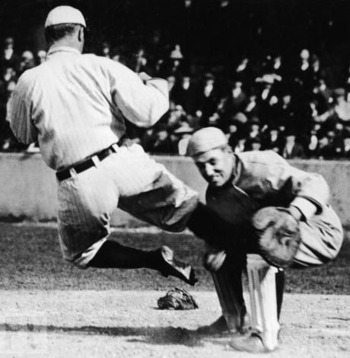
Let me tell the you the story of Ty Cobb. Cobb was arguably one of the greatest baseball players to ever live. He was the first to be inducted into the Baseball Hall of Fame, and in my opinion he stands just behind Hank Aaron and Honus Wagner. When he played, he played with his whole being. One sports writer of the time wrote that he believed Cobb would continue to play ball even if he were charged for the privilege. Yet, he was also the most despicable, the dirtiest, and most hated player of all time. In fact, he may be the most hated player in sports history. Cobb said that to him baseball was like a war and he would do whatever it took to win... whatever it took. The picture above is a good illustration of what he would do to catchers to ensure that they would drop the ball. He kept his spikes sharpened and would slide into a base with them high in an attempt to spike the opposing players in their shins or knees. On a steal or a possible double play ball, Cobb would throw his whole body at a second baseman or shortstop when sliding into second. Many men were carried off the field on stretchers because of Cobb's base-running assaults. In batting, if he could not get a hit off a pitcher, he would lean into pitches to get hit by the pitch. Of course, that is just what he would do to opposing teams. Even his own teammates hated him because he would pick fights with them if they did not play the game the way he thought they should play (i.e. dirty). In fact, he would fight anyone for anything--umpires, teammates, and even fans. He once tried to kill a grounds-keeper because the keeper was a black man who dared to say "Hello" to Cobb, and then when Cobb's teammates pulled him away from choking the poor man, Cobb turned on them. Cobb stabbed a security guard because he simply asked him to identify himself when entering an opposing team's park. He even ran into the stands on a several occasions to beat up fans that heckled him. Cobb once said in an interview, "Sure I fought. I had to fight all my life to survive. They were all against me; tried every dirty trick to cut me down, but I beat the bastards and left them in the ditch." No one could touch him, however, because Ban Johnson (the AL president at the time) would not let them. He knew Cobb was dirty and a cheater, but Cobb was also one of the best players in the game and his controversial tactics sold tickets. (Johnson did suspend him once for beating a crippled fan nearly to death but lifted it very quickly because of the monetary losses.)

Why was Cobb so angry at the world and so determined to win at any cost? To answer that, we have to go back to his childhood. Cobb was born on a Georgia farm. His father, William H. Cobb, was a hard task master and was determined that his son would "make good" in medicine, law, or the military. His father was demanding, distant, and "the only man whoever made me do his bidding," according to Ty. Nothing he could do would ever satisfy his father, however, and it drove the angry young boy to succeed at any cost. When he left home at age 17 to play baseball in the minors, his father's parting words were, "Don't come home a failure." Cobb said, "That admonition put more determination in me than he ever knew. My overwhelming need was to prove myself as a man." But, he did not succeed right away and no one noticed him, so he cheated, forging scout letters about his "unusual amount of talent" in order to get offers. His forgeries worked, but just three weeks before he made his Major League debut with the Detroit Tigers, his father was accidentally shot by his mother. She saw him sneaking in the window, thought he was a prowler, and shot him twice with a shotgun. Cobb's father died before Cobb could prove himself and that demon chased him throughout the rest of his life. When Cobb was being interviewed as an old man he said, "I didn't get over that. I have never gotten over it." Deep in his heart he was still an angry child who desperately needed his father's approval, so he was driven to succeed no matter the cost. He made everyone an enemy and fought to prove himself to a ghost for the rest of his life.

The story of Ty Cobb is a great illustration of the quote above by Robert Lewis. Cobb's father was distant, and he withheld his love and approval from his son. Most importantly, Cobb never learned from his father what it meant to be a man, nor did his father ever bestow manhood on him. So, Cobb drifted and made an enemy of the world. He learned implicitly that he had to be the best in order to be a man, and it did not matter to him how he ended up on top as long as he was there. But, enough was never enough. It was all vanity, chasing after the wind. Perhaps if Cobb's father had lived, the approval and affirmation of manhood that Cobb needed would have eventually been given. But, since Cobb's father died early on, he never got the approval or affirmation he so desperately needed. He fought the rest of his life for it, but no one could give it to him except his father.

As R. Lewis notes above, fathers have an inexplicable power over sons. Very few things are more important to a man than the approval and affirmation of his father. The football and baseball star Bo Jackson once said in a Sports Illustrated interview:
My father has never seen me play professional baseball or football.... I tried to have a relationship with him, gave him my number, said, "Dad, call me. I’ll fly you in." Can you imagine? I'm Bo Jackson, one of the so-called premier athletes in the country, and I'm sitting in the locker room and envying every one of my teammates whose dad would come in and talk with them after the game. I never experienced that.
Young boys need approval, to be taught what it means to be a man, and the affirmation of that manhood from their fathers, and without it they drift. They go looking for answers, approval, and affirmation from somewhere else. When they don't get it from him, they will go looking for it wherever they can see a glimmer of hope--women, men, sports, gangs, success, etc. But, none of those things can give them what they need and so the search will never end. They can never have enough sex, enough trophies, enough fights, or enough success to prove their manhood and win the approval of an absent father. They will be seeking to prove themselves to a ghost for the rest of their lives. I am not saying that every one will end up as angry and driven as Ty Cobb but I agree with R. Lewis--when fathers are absent (physically or emotionally), sons drift. They do not know what it means to be a man and they are left to wander the world, answering any call that promises answers, approval, and affirmation. (Go here for a whole host of staggering statistics about the adverse affects of fatherless sons.)

For those of you who know me, you know this is an important issue to me. However, now it has become much more personal. My wife is pregnant with our first child and it is a boy. I look around and see drifting men whose fathers were absent (about one third of American households are without a father and that is just physical absence, not to mention emotional), and I tell myself, "I will be there for my son." Yet, just being there is not enough. How will I teach him what it means to be a man and call him into manhood so I can affirm it for him? That is a huge question because if he does not get the answers from me, he will drift. I need to have the answers to (at least) the following questions: What is a man? What are his responsibilities? What does a man believe? How does a man behave? What should a man try to achieve? How does he withstand cultural pressure to the contrary? He will need from me a vision for manhood, a code of conduct, and a cause for which to live. Without it, he will drift.

Can you answer those questions for your son(s)? If not, I challenge you to find the asnwers because as the men go, so goes the society. Sociologist Margaret Mead wrote in her study of sexes and societies, "The central problem of every society is to define appropriate roles for the men." (p. 168) And, it starts with fathers.

A great resource I have discovered is a ministry called "Men's Fraternity." I know it sounds a little lame but they have excellent resources for a biblical view of manhood, raising sons, raising daughters, integrating family and work, and so much more. A good book to read is the one mentioned above, from which I quoted: Raising a Modern-Day Knight: A Father's Role in Guiding His Son to Authentic Manhood. I have not finished it yet (and when I do I will write a review of it), but I am impressed with it so far and I do not mind already recommending it. Another resource I discovered recently is a thesis paper by a RTS MA student. It is worth reading as well. If those are not enough, search for more. It is not easy because there is a lot of junk out there to sift through, but your son is depending on you.

By His Grace,
Taylor